

Author’s Note:
This piece is longer than I originally intended. I felt that I could not tell the story honestly by separating what Niagara meant from what happened to the community around her. I wanted to hold my thoughts together in one place: what Niagara meant, what the League built, how that community was dismantled, and why it still matters. I will follow this with a shorter three-part series covering individually: what we lost with Niagara, how we got here, and what I hope we can do to rebuild.
I came to the Brig Niagara for the first time in 2009 as a 17-year-old trainee.
I was originally born in Erie, but by then I had spent much of my childhood overseas and on the move. My grandmother, hoping to lure me home for the summer before I left for college and knowing my weakness for harebrained adventure, signed me up for a three-week voyage aboard the ship as a liveaboard trainee.
Her plan backfired almost immediately. I fell completely in love with Niagara and wheedled my way into staying aboard for the rest of the summer. My family eventually had to drive all the way to Port Colborne, Ontario, just to see me for a day before I flew off to school.

But, as usual with my grandmother’s grand schemes, she won the war.
I kept coming back to Erie. I kept coming back to the ship. I kept coming back to the people I found there until, eventually, Erie became home again.
By the time I left Niagara at the end of that first summer, I was not the same awkward, uncertain kid who had stepped aboard. The ship gave me something I did not yet know how to name: confidence, discipline, belonging, and a glimpse of the person I might become.
At the time, I did not understand that Niagara herself was also in a moment of change. After the 2008 financial crisis, state budgets were under pressure. To save costs, the Pennsylvania Historical and Museum Commission (PHMC) was prepared to convert Niagara into a static exhibit: a historic object at a dock, easier to budget, easier to control, easier to fit inside the familiar structure of a museum.
But Niagara was never meant to molder behind a rope as an academic display.
The Flagship Niagara League (FNL) fought to keep her alive as a sailing vessel: an ambassador for Pennsylvania, a training platform, a civic symbol, and a place where people did not merely learn history, but discovered discipline, confidence, service, and purpose.
I saw it happen time, and time, and time, and time again with students, volunteers, crew, staff, and the multitudes of people who stepped aboard uncertain of themselves but left somehow larger.
After significant public pressure, the state agreed to provide roughly what it believed would be required to maintain Niagara as a static exhibit: $350,000 a year, not indexed for inflation. The League would raise the rest through programming, fundraising, voyages, Tall Ships Erie, and the stubborn generosity of a community that refused to let its beloved ship go silent.
That bargain was not perfect. It could not have been. A volunteer-rooted nonprofit suddenly had to become a maritime operator, development office, maintenance program, training school, public ambassador, and preservation organization.
But it worked because people made it work.
The League raised the money to retain the crew to operate and maintain the ship. Volunteers gave weekends, winters, bodies, and hearts. Some drove hundreds of miles for a single weekend to scrape, paint, tar, stitch, varnish, haul, sand, rig, clean, and teach. Some came for a season and stayed for decades. Some found friendships. Some found careers. Some found themselves.
I became one of them.

Over the next sixteen years, everything I learned in school, work, and life found its way back to Niagara. My EMT and firefighting training became a way to serve as medical officer. Deck work taught me leadership, patience, and communication. Restaurant and catering work became useful when the ship needed help in the galley. A carpentry apprenticeship gave me the foundation to help in the woodshop and occasionally assist the shipwrights. When engineering work needed extra hands, I learned diesel maintenance, plumbing, and electrical systems. Eventually, my computer science background became useful to the League’s programming, communications, outreach, administration, and technology work, and I came to serve on staff as Director of Information Technology.
The closer I grew to Niagara, the more she gave my curiosity somewhere useful to go. She let me bring my whole self to something good.
Every odd skill, every learned trade, every hard-won lesson could find a place aboard her or around the League. And in that work, the bond became physical as much as emotional. I feel that there is enough of my blood, sweat, and tears in the wood of that ship that she is practically a relation.
But that was not unique to me.

That was the nature of Niagara. She made people part of her by asking something real from them. My shipmates carried the same marks: scarred hands, tired backs, tarred clothes, paint under fingernails, stories, laughter, exhaustion, grief, pride. The ship became family because we gave ourselves to her together.
In weather fair and foul, that community made Niagara more than wood, canvas, iron, and line.
They made her real.
And Niagara, in turn, has a tendency to make people better than themselves.
Ship, Shipmate, Self
In the crew manual I was given in 2009, Senior Captain Walter Rybka defined the ethic that shaped Niagara’s culture:
“As trainee and professional members of the U.S. Brig Niagara crew, we should remember and live up to this axiom: ‘Treat Your Shipmate As Yourself’. This is the golden rule. In Niagara, we use the motto ‘Ship, Shipmate, Self’, which means serve first the Ship, then your Shipmates, then Yourself. While this motto is keenly appropriate for any training ship, as this section implies, you are not serving the ship if you are not serving the best interests of your shipmates….”
That last sentence matters.
“You are not serving the ship if you are not serving the best interests of your shipmates.”
“Ship, Shipmate, Self” was never a demand for blind obedience. It was not a command to submit to whoever held the keys, the contract, or the press release. It was an ethic of mutual obligation. It meant the ship came first, but it also meant the ship could not be separated from the people who served her.
That is why what happened between the Flagship Niagara League and PHMC cannot be reduced to a contract dispute. It was not merely a disagreement over paperwork, funding, insurance, or who got to speak for the vessel.
It was a struggle over the meaning of stewardship itself.
The League understood Niagara as a living community in service of a mission.
To my eyes, PHMC increasingly treated her as an exhibit, a showpiece, and a possession.
The Mistake They Never Forgave
I have two main reasons for writing this.
The first is personal. This is a defense of, and a love letter to, the community I came to love: the extraordinary kaleidoscope of people who stepped aboard, showed up, and gave so much of themselves to make this beautiful and improbable thing possible.
The second is an attempt to answer a question I have heard again and again from the public:
Why did PHMC sour in their relationship with the Flagship Niagara League? Where did it go wrong?
To be honest, we were never given a clear, honest answer. There were statements, implications, shifting explanations, and carefully managed public messages, but no direct accounting that matched what we experienced.
For a long time, I tried to give PHMC the benefit of the doubt. Maybe this was the result of escalating personality conflict. Maybe it was poor communication. Maybe it was bureaucracy and administrative rigidity colliding with the temperament of sailors, who have never been known for being easygoing regarding the care of the vessels under their command. Maybe after FNL hired the crew, PHMC simply no longer had anyone in house who understood the enormous complexities involved in operating a historic sailing vessel.
The records shared by Protect Brig Niagara ended that illusion for me. They showed me that the trials and disputes we had experienced were not isolated misunderstandings. Looking into the conversations happening on the other side showed that they were part of a pattern. PHMC seemed to see FNL’s capacity, not as a passionate community that worked to help keep Niagara alive, but as something that had to be brought to heel.
I have not included every document here. The source record behind this article is much larger: emails, Right-to-Know documents, board materials, audit records, Coast Guard correspondence, public reporting, and contemporaneous notes. I have tried to keep this article readable while preserving enough of the record to show the pattern.
In the years since “the divorce,” as the museum’s Site Administrator James Hall frequently called it, I have come to believe that PHMC never forgave the public for forcing them to keep Niagara sailing. The League’s success became a living reminder that the state’s plan to reduce her to a static exhibit had been overruled.
After the financial crisis, FNL did what the state had been unwilling or unable to do: kept Niagara sailing, built public support, raised money, retained crew, maintained the vessel, made her history accessible, and fostered a community that understood her as more than an artifact.
For years, the state’s base support stayed fixed while the community supplied the rest. We kept Niagara alive with labor, skill, relationships, fundraising, ingenuity, sacrifice, bruised elbows on spars, and wearied shoulders under burdens.
She survived because shipmates kept showing up.

By 2019, FNL was no longer merely surviving. It was hitting its stride.
The organization regularly brought in an annual budget in excess of $1 million beyond the stipend provided by the state, and that money went directly into the operation, maintenance, interpretation, and public life of the ship. The League preserved institutional knowledge. It built programming. It organized volunteers. It made Tall Ships Erie possible. It strengthened its internal infrastructure and began building the governance, policies, and professional systems needed to support a complex maritime nonprofit.
FNL’s educational partnerships were also deepening. The League was working with schools and colleges on marine ecology, regional science, and historical interpretation programs, expanding Niagara’s role beyond seamanship alone. During uprig, FNL also developed informal cross-training opportunities with crew from USS Constitution, who joined the Niagara community to practice traditional seamanship and rigging skills. The ship was becoming a platform not only for sailing, but for history, science, ecology, leadership, and the preservation of maritime craft.
That same period showed what Niagara could mean far beyond the dock. Tall Ships Erie brought enormous public energy to the waterfront, welcomed visitors from across the region and beyond, and generated an estimated $8 million in regional economic impact over a single weekend event.
The Flagship Niagara League’s work was not only felt locally; it was recognized nationally. FNL and its partners received numerous awards for programming, public impact, and sail training, including a 2016 Economic Impact Award, Tall Ships Challenge Sail Training Program of the Year recognition in 2019, Port of the Year honors for Tall Ships Erie in both 2019 and 2022, and Sail Trainer of the Year recognition for Captain Sabatini in 2022.
These awards reflected what the Erie community already knew: the League had built more than an event schedule. It had built a living program of education, stewardship, tourism, and maritime training around Niagara.


No human organization can achieve perfection, and the League was no exception. Organizational discipline, policy, and infrastructure were being built on the fly to meet a herculean need. But FNL was growing into the work. It was becoming more capable, not less. It was turning a fragile funding arrangement into a living institution.
You can therefore imagine my surprise when I learned that in 2020, Charlie Fox, then PHMC’s Western Division Chief, reportedly told FNL’s Executive Director William Sabatini that “the worst mistake [PHMC] ever made was letting FNL get its hands on the ship.”
In a formal witness statement, Sabatini recalled another comment from Fox shortly after the retirement of the previous Site Administrator: Fox said he was “bringing someone in here to piss people off.” That person was Tyler Gum, who served as the Museum’s interim site administrator and later took over Fox’s role as Western Division Chief. In another meeting with Gum and the FNL board president, Sabatini observed that FNL was the only PHMC associate group with an executive director. Gum reportedly replied: “No, you’re the last. And we’re trying to fix that.”
That notion has stayed with me because it explains so much of what followed. What the state saw as a mistake was the very thing that, to me, had saved Niagara.
The League did not take Niagara away from the Commonwealth. It helped the Commonwealth keep the living flagship it was chartered to maintain when the state had been prepared to settle for a static display. Meanwhile the more capable the League became, the less PHMC seemed to tolerate it.
The volunteers who founded Protect Brig Niagara later helped me understand the scale of that resentment. They were kind enough to share many of the records they uncovered in raw form, and it has taken me time to digest what those records showed. Reading them was painful. It forced me to revisit events I had lived through and see them not as disconnected disputes, but as pieces of a much more directed pattern.
The 2009 agreements that allowed FNL to operate Niagara were born from public insistence that the ship remain a sailing vessel. But those agreements had expiration dates. As they neared their end, PHMC’s posture hardened. The League was still trying to build a durable partnership; PHMC appears to have been waiting for its chance to retake control.
Perhaps we were naive. It certainly feels that way now.
Approval, Reversal, and Manufactured Confusion
In 2021, following the uncertainty and deferrals due to COVID restrictions, FNL was eager to get Niagara the care and shipyard work she needed, with the hope that operations might resume if conditions allowed. After a meeting about possible Niagara operations, Captain Christopher Cusson wrote to the Site Administrator, James Hall: “It is best for everyone, the ship, the Erie community, and the Commonwealth, if we can get Niagara sailing and be visible to the public in whatever way we can…”
He also noted that September 1 would be the last practical date to begin sailing that season.
In April, after repeated requests for approval to remove Niagara’s cover with volunteers, Hall replied with only: “Yes!”
FNL then did what it had always done. It organized people around the ship’s needs. PHMC staff were included in correspondence. Access policies were checked. Rules were followed.
People were excited to get back to work because the ship needed care and the community wanted to serve.
Then came the reversal.
Not through a direct conversation. Not through a collaborative meeting. Not through a good-faith clarification. Without warning, as the volunteers gathered outside the ship to muster and begin work for the day, FNL received a formal cease-and-desist style notice stating that PHMC had not given permission to sail or use Niagara, that the League should not remove the canvas covering, and that summer crew hiring should be suspended. Whether intended or not, the effect was chilling to FNL and many of the volunteers.
That became the pattern in miniature: discussion, approval, action… and then a sudden assertion that permission had never existed.
Later, when a misleading news story shaped by PHMC messaging claimed that FNL and PHMC had agreed Niagara would not sail that summer, the League objected. PHMC ignored those objections. FNL then prepared a response documenting what had actually been discussed all while keeping public messaging positive. In that response, the Captain stated that he had directly asked the Site Administrator whether PHMC would allow Niagara to sail if the League paid for a spring shipyard period. In a formal report to the board, FNL’s executive director recorded the Site Administrator’s answer: “I don’t see any reason why not.”
Rather than reconcile that contradiction, PHMC established a position that made accountability nearly impossible. FNL staff were told that the testimony of PHMC staff was the only official source of truth regarding policy, even over PHMC’s own prior emails, meeting minutes, public statements, and written communications. The record only seemed to matter when it served the Commission. When the record contradicted the Commission, the Commission claimed the authority to override it.
Staff concerns were treated the same way. When FNL raised concerns about mistreatment by PHMC personnel, they were contextualized as mere “contractual disputes” rather than human-resource concerns. Claims of harm became abstracted paperwork and left League staff feeling subject to PHMC’s control without the protection they would be offered either as employees or even general members of the public.
With the ability to define the record, came the ability to redefine the relationship. And the relationship PHMC seemingly wanted was not a partnership. It wanted control: control of the League’s access, money, messaging, volunteers, and public credibility.
When Partnership Became Extraction
PHMC’s treatment of the League reflected a deeper flaw in its associate-group model. An independent study on private-public partnership years before had already criticized PHMC’s approach as “command and control,” warning that friends groups were often expected to raise money, manage volunteers, employ staff, and absorb risk while holding little real authority over the sites they supported.
That was exactly the trap FNL lived inside. PHMC wanted the League’s nonprofit status, donors, grants, volunteers, staff time, budget, hiring capacity, and public goodwill without question. But it did not want a true mission partner with fiduciary duties, donor obligations, maritime expertise, or the ability to say, “No, that does not serve the ship.”
Worse, the study noted with surprising foresight, that PHMC associate groups had little real security: they could be shut down by PHMC at any time. That kind of structure makes honest stewardship nearly impossible. How can a nonprofit responsibly promise donors how their gifts will serve a mission when the state can override priorities, redirect control, or dissolve the relationship whenever the partner becomes inconvenient?
The League put its concern bluntly in notes prepared for the Northwestern Pennsylvania Delegation, the state senators and representatives whose districts include Erie and the surrounding region. To FNL the new agreement appeared “intended to convert FNL from an independently led citizen’s organization to a subsidiary pass-through fiscal conduit.”
That phrase named what many of us felt: PHMC wanted the League’s resources, but not its partnership. It wanted the donors, volunteers, labor, mailing lists, grant access, and goodwill FNL could provide, but not an organization with its own mission, expertise, and duty to advocate for the ship and the people who served her.
Evidence of that dynamic showed up repeatedly.
The Site Administrator frequently dismissed the League as a “private sailing club,” as though the people who sailed, maintained, taught aboard, fundraised for, and interpreted Niagara were somehow deliberately keeping the public away from her.
That accusation rings hollow now.
Since the state took control, public access to Niagara has been dramatically reduced. Volunteer opportunities have been narrowed. Participation has been restricted. Access has often seemed to flow through selected friends of the Museum rather than the broad, committed community that once kept the ship alive. We are told this will change when Niagara returns from shipyard this year, but nothing about the process so far has earned that trust.
The League’s sailing program did not privatize Niagara. It publicized her. It carried her to Erie schoolchildren, trainees, festival visitors, port communities, donors, volunteers, and the broader Great Lakes public. During festival circuits and Tall Ships Erie, the League put Niagara in front of crowds the Museum could never have reached by keeping her tied behind the building. She was not less public because she sailed. She was more public because she sailed.
The problem was not that the public lacked access under the League.
The problem seemed to be that the museum did not get to reap all the credit.
Another moment, later reported by FNL’s bookkeeper, showed how casually the Commission treated the League’s name and nonprofit status as tools for its own use. The Erie Maritime Museum’s Site Administrator had reportedly tried to hand her a check for what he described as a grant, made out to FNL for a specific museum project. The League had not been told in advance about the application, the discussions with the foundation, the grant’s purpose, or the terms under which it was expected to serve as fiscal sponsor. FNL’s position was simple: it could not legally or responsibly cash the check without first understanding the terms, allocation, obligations, and accountability process and we requested a discussion to resolve it. To my knowledge, there was no meaningful follow-up from Commission staff.
The same pattern appeared around the schooner Lettie G. Howard. The League brought Lettie into its programming as one more way to support Niagara’s mission. Niagara is a magnificent sail training platform, but she is not well suited to short day-sail programs. Her rig is complex, her operation requires a large crew, and her deepest educational value often comes through immersion over time. Lettie, with her leaner schooner rig, could keep public programming alive in Erie when Niagara was voyaging, under maintenance, or unavailable. She served Niagara by making the mission more resilient.
Although Niagara was kept from sailing in 2021, FNL still worked to preserve one of its most meaningful annual traditions: bringing Erie School District eighth graders onto the water for hands-on maritime education. Because Niagara was unavailable, FNL shifted the sailing portion of the program to Lettie and funded it through EITC allocations restricted for educational programming.
The program could have brought students directly to the Erie Maritime Museum and strengthened the museum’s connection to the community. Instead, the museum’s new security policy became another point of leverage. PHMC claimed FNL could not operate from the museum slip because the sails ended after the reduced museum hours, even though afternoon day sails returning after museum hours had been standard practice aboard Niagara for years.
The Site Administrator then said FNL could continue using the museum only if the League turned over roughly $40,000 for museum staffing, nearly the same amount FNL had just raised through Erie Gives for general operating funds. But shared fundraising requires collaboration and communication up front. The demand came only after the Erie Gives money had already been raised and allocated to FNL’s limited operating costs. To many of us, conditioning student programming on surrendering donor-raised operating funds felt coercive, if not extortive.
So the League moved the program off site, where students could still sail aboard Lettie and participate in additional education like knot tying and maritime history. PHMC still tried to claim FNL could not run the program under a policy PHMC had written for itself, one that placed all programming, “regardless of location, size or audience,” under museum supervision, gave the Site Administrator final approval over content and scheduling, and reiterated a declaration that all volunteers served solely at the pleasure of PHMC. At the same time, PHMC continued to insist that Lettie had no official relationship with the museum.
The League, focused on serving the community, ran the program anyway.
Tellingly, PHMC still expected the attendance numbers so it could count those students toward museum engagement. The program was unaffiliated when PHMC wanted distance from responsibility, but apparently connected enough when the numbers helped the museum’s reporting.
It feels safe to say that the Commission clearly did not see the League as a mission partner but rather as a wallet, a mailing list, a grant vehicle, and a labor pool… useful only so long as it remained obedient.
Reputation as a Weapon
Reputation became the next battlefield.
PHMC and its representatives made accusations against the League behind closed doors without giving FNL a meaningful opportunity to respond. They complained to public officials and program partners. They questioned our motives, competence, and integrity while keeping their actual concerns vague, private, and distorted while communicating with FNL leadership.
In notes to the Northwestern Pennsylvania Legislative Delegation, the League described “unfounded and slanderous allegations of financial malfeasance voiced publicly to volunteers and incoming FNL staff.” It also described past threats of “retribution” if FNL contacted elected representatives or challenged inaccurate statements made by PHMC.
An incident in the museum store showed the same posture in microcosm. An FNL staff member opened the small museum gift shop one morning and found prints, posters, and materials valued at several thousand dollars missing from the stockroom. No one had told anyone from the League that they were being removed.
When I eventually learned they had been collected at the Site Administrator’s direction, I was told the collection of the prints was part of a reconciliation process between PHMC and the League:
“You guys owe us money, we owe you money. That’s what this is all about since you guys aren’t an associate group anymore… All these things are bubbling to the top now so there’s a bunch of things to hash out…”
What alarmed me was not simply that PHMC believed some merchandise belonged to the Museum. I stated that I would be happy to pull the items from inventory and set them aside if there was a dispute so that we could reconcile the differences responsibly. Instead, the items were taken without notice. The same thing occurred again with other retail items while the ship was away.
At the time, I was responsible for building systems to help manage inventory, reporting, and audit trails. When inventory vanishes without explanation, it creates a real problem for the organization that has to account for it.
This was the pattern: PHMC acted first, communicated later, and left the League to absorb the operational and reputational consequences.
The same pattern appeared in financial accusations.
In a written summary of an August 24, 2021 meeting with Hall, an independent representative of Niagara Volunteers reported Hall saying that he had disbursed around $1 million to FNL, that Niagara was not operating, and that he had not received receipts accounting for where the money was going. The summary further states that Hall repeatedly wondered aloud where the money was going because Niagara did not need much money tied up at the dock, and that the implication was that the League was embezzling the money, though granted, Hall did not say that outright.
The facts were available through ordinary channels. PHMC’s annual operating support was the long-standing $350,000 allocation, and FNL had consistently reported that those funds largely supported, but did not fully cover the crew and staff salaries required to maintain, interpret, and operate Niagara. Later Keystone grant funds were tied to ship maintenance, and FNL provided detailed reports and receipts for those grant-funded expenses. The League also completed PHMC’s annual associate-group questionnaire, invited the Site Administrator to its regular board meetings, and reported its finances through annual independent audits.
FNL’s systems were not perfect. The organization had grown quickly in the years following 2009, resources were tight, and the League was already looking for outside support to help manage the administrative overhead. But imperfect administration is not embezzlement. The implied accusation was not supported by the League’s annual audits, the state’s financial review, or a specially requested state efficiency audit, which found no wrongdoing and identified only ordinary process improvements FNL was already working to strengthen.
But accusations like that do not need to be true to do damage. They only need to be repeated.
Repeated to create suspicion. Repeated to scare partners. Repeated to give public officials a reason to hesitate. Repeated to make a community look untrustworthy before it has a chance to defend itself.
Shortly after the League’s contract with the state was terminated, in an email regarding the League’s continued collaboration with a community partner, museum staff indicated that the partner should “[bring] in an exterminator to get rid of the rats”
The people who cared for Niagara through the hazards of regular maritime operations, recession, COVID restrictions, shipyard planning, staffing shortages, state delays, and financial strain were suddenly compared to vermin. The people who had been trusted to live aboard, maintain, sail, teach aboard, and respond to crises in service to Niagara were seemingly told they could no longer be trusted near her.
The Rules Were Never Neutral
There is nothing wrong with having rules, after all good fences make good neighbors.
Ships need rules. A vessel like Niagara, carrying the weight of history, public money, maritime law, Coast Guard oversight, and community expectation, should not be governed casually.
The problem was not the existence of rules.
The problem was that the rules were not equitable or even neutral.
They were treated as absolute when they could be used to control the League, and flexible when they became inconvenient for PHMC.
Access was one example. The state wanted strict controls around the ship, even though it had long relied on League staff, crew, and volunteers after hours when the museum flooded, weather shifted, lines needed attention, or ships required checks. The same people who had been the primary caretakers of Niagara for more than fifteen years were suddenly treated as though they could not be trusted with access to her.
Communications followed the same pattern. When the museum wanted something published, the expectation was that it should happen immediately and without question. The League, however, was expected to submit to a painfully slow process while educational posts, fundraising messages, operational updates, and public statements often sat for weeks awaiting review by the state.
The selective respect for rules showed up most clearly in the way PHMC handled hiring.
When the Commission took control of Niagara, it assured the public that former League employees would have the chance to apply for positions with the ship. The Commission’s former director of external affairs, Howard Pollman, announced in public reporting:
“We welcome FNL employees to apply for positions within PHMC as they post.”
The same reporting said the new model would include hiring a full-time captain, chief mate, shipwright, and seasonal crew, with those positions “open for all qualified candidates to apply.”
But the process did not match the promise.
One of Niagara’s former captains, a Coast Guard veteran who had successfully sailed with the vessel for over a decade, expressed clear and direct interest in applying to museum leadership. Under Pennsylvania hiring laws, that should have mattered. The Commonwealth’s own employment guidance states that qualifying veterans may receive preference when applying for Commonwealth jobs, and for non-civil-service appointments like the captain role, qualified veterans who meet the established requirements must be interviewed and, if the hiring manager determines they meet all requirements, must receive a conditional offer of employment.
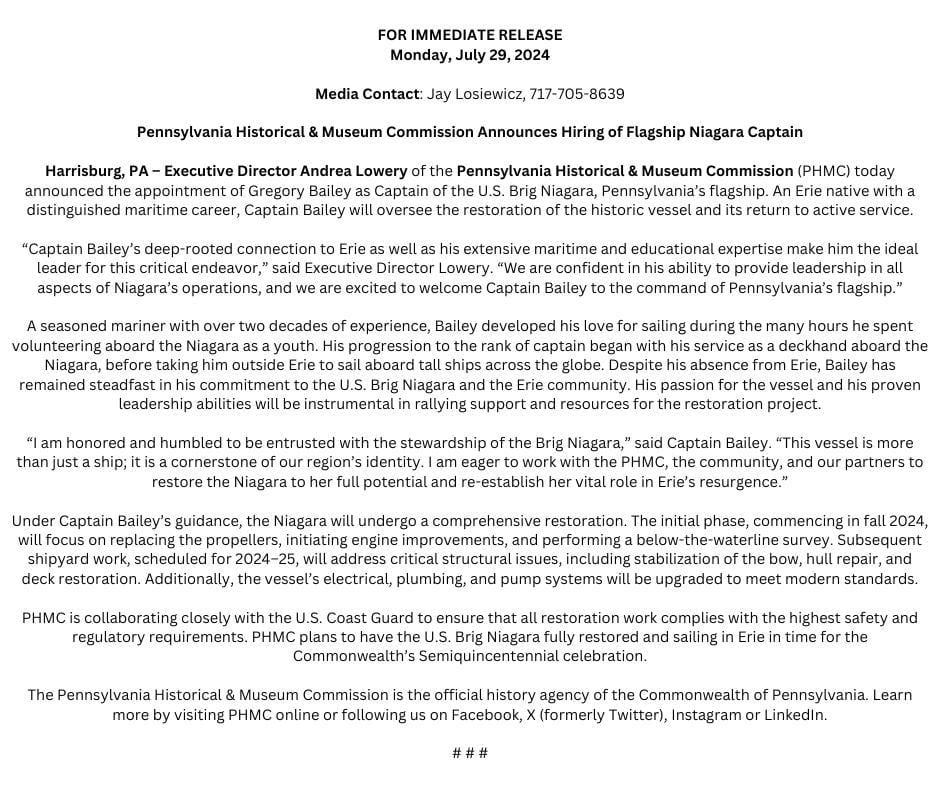
Instead, without a public opening or any meaningful indication that a search was finally underway, the final announcement came not as the conclusion of a transparent process, but as an appointment. On July 29, 2024, the Commission announced the appointment of a new captain of the U.S. Brig Niagara. Documents later revealed that Commission staff reached out through political channels to bypass normal hiring procedures and appoint their favored candidate.
PHMC staff certainly seemed to know that their actions did not resemble the open process they had assured. In an email to their prospective candidate, the Site Administrator asked that the applicant’s status as “potential new captain” be kept “on the down low” because this was a “non-traditional” hiring protocol. He acknowledged that it was “a departure from the traditional ‘post to the public & then select from the list’ state hiring protocol,” while insisting it was “completely legit.” The email speaks for itself: this was not an accidental failure to post a job. PHMC knew it was using a different process while publicly assuring former FNL crew that positions would be open to qualified applicants.
This pattern persisted.
When Niagara had to be moved to the shipyard for new propellers, survey, and short-term maintenance, the Commission did not publicly advertise crew positions or offer an opportunity to the local sailors who knew the vessel. Instead, it used a no-bid arrangement with a private contractor based in Nova Scotia. The Philadelphia Inquirer later reported that the voyage violated federal maritime code requiring the crew of a Coast Guard-registered vessel to be U.S. citizens.
To be entirely clear, the problem for me is not that the mariners were Canadian, nor is it with the operators themselves. Tall ships are an international community, and protectionist laws are often a blunt and ineffective instrument. Many of us have sailed with, learned from, trusted, and worked beside shipmates from other countries.
The problem was that PHMC seemed so determined not to rely on the experienced local Niagara community that it routed around those people entirely and either failed to evaluate the legal requirements or proceeded despite them. The result was the same: on one of its first major movements under state command, PHMC’s chosen arrangement drew a Coast Guard warning for violating federal maritime citizenship requirements.
PHMC often spoke to the League in the language of rules.
Rules for access.
Rules for communications.
Rules for volunteer engagement.
Rules for crew housing.
Rules for contracts.
Rules for dock use.
Rules for who could speak, who could enter, who could work, and when the public was allowed to know what was happening to the ship PHMC had been charged to care for.
But when the state needed to crew the ship without the community it had pushed aside, suddenly the rules were negotiable.
The behavior resembles an old adage… “For my friends, everything… for everyone else, the law.”
How Sacrifice Became Leverage
The same dynamic played out at the scale of Niagara’s long-delayed refit. PHMC now points to roughly $5 million in capital repair money as proof of its stewardship. But those funds, rooted in a repair allocation granted in 2014 by Governor Corbett, were not simply handed down by a benevolent state agency. They were available because the League and its community helped fight for them. FNL staff, crew, board members, volunteers, and supporters worked with museum staff to make the case that a living wooden ship requires serious cyclical investment. The League helped document the need, built the public case, supported the planning, and kept Niagara visible enough that elected officials understood why she was worth preserving.

That money exists because Niagara was still alive, still sailing, still teaching, and still loved. It exists because the League helped make the need impossible to ignore.
The bitter irony is that PHMC now uses those funds as evidence of its own care while dismissing the community whose labor, expertise, advocacy, and credibility helped secure them. The state is spending money the League helped make possible, while writing the League out of the story.
By 2022, the League was already under serious financial strain. The pandemic and reduced operations had cut into revenue, and Niagara’s long-promised refit had been delayed again and again since that funding was announced in 2014.
The record shows that PHMC understood this problem well before the final break. In January 2020, Captain Sabatini wrote that the refit had been “next year” for many years and that PHMC’s commitment to fund deferred maintenance would allow FNL to retain crew, plan sail-training programs, and keep Niagara sailing while the larger project remained out of reach.
PHMC’s response was not to move the full refit forward. Instead, it asked FNL to help break urgent work into smaller Keystone-funded projects: waterways, stem reinforcement, transom framing, survey work, and critical repairs. Each required scopes of work, phasing, deliverables, reporting, receipts, payroll documentation, and reimbursement procedures. In theory, those requirements were reasonable. Public money should be accountable. But in practice, PHMC was asking an already stretched nonprofit to carry the planning, administrative burden, and operational risk created by the state’s own delay.
To get Niagara sailing again and sustain her programming, FNL’s board and membership voted to draw from the League’s endowment and fundraise additional money to cover the ship’s needs, even at risk to the organization itself. That was not recklessness. It was “Ship, Shipmate, Self” made real. The plan was to use fundraising, programming income, and the 2022 Tall Ships festival year to rebuild what had been spent.
And we did.
Niagara sailed. Even with more modest crewing, and a shortened season, FNL’s programming persisted. The public, even with the uncertainties following the pandemic, came back. The League turned sacrifice into renewed momentum.
But even then, the state kept squeezing. It demanded increasing cuts of League fundraising revenue while restricting the messages FNL could use to raise those funds. Because the state had begun contributing to ongoing maintenance, it claimed the League could no longer tell donors that their gifts would support Niagara’s maintenance despite how that work had always been central to the League’s mission and fundraising.
That contradiction was maddening. The state delayed the refit, asked the League to develop smaller maintenance proposals, imposed extensive proposal requirements, restricted maintenance fundraising language, and then demanded more of the revenue the League managed to raise anyway.
As 2023 approached, the League had already identified the need to replace Niagara’s propellers in previous shipyards and had petitioned for funding to do the work as part of those smaller capital campaigns. The money did not come for those projects, and the work was not done.
And once again, the people who had been warning, planning, fundraising, and trying to care for the ship were treated as the problem.
This financial pressure did not end with the shipyard. After PHMC took over reimbursement of maintenance costs in 2023, it delayed payments to the League to the maximum review period. By the time the contract was terminated, PHMC still held roughly $450,000 in significantly aged payables owed to FNL. For a state agency, that may have been a procedural sum, but at this point for the League, it was oxygen. Whatever PHMC’s stated rationale, the effect was to squeeze the organization while demanding further control in any future dealings.
The consequences of their behavior were not abstract.
The Cost of Delay
In July 2023, Niagara lost her starboard propeller, and the Coast Guard issued a vessel inspection requirement before she could operate again as a Sailing School Vessel. That alone was serious. But by October, the danger was larger than a missing propeller.
Niagara also needed her regular out-of-water inspection to maintain her Certificate of Inspection (COI), the document that allowed her to sail with trainees and conduct public deck tours. That inspection was part of the maintenance plan the Coast Guard had conditionally permitted while Niagara’s long-overdue refit continued to be delayed. It was not optional housekeeping. It was part of the exacting legal and operational framework that allowed Niagara to remain a living vessel.
That framework was already delicate. Niagara does not fit neatly into modern vessel standards. Her Certificate of Inspection existed under special exemptions tied to her historic construction, her configuration, and her stability limitations. Those limitations are why she uniquely has such high licensing and crewing requirements for her size. They are part of why the League had long wanted to increase her draft and improve her safety margins during the refit… improvements that were not applied during the most recent shipyard. They are why losing the Certificate of Inspection was not simply a matter of filing new paperwork.
If Niagara’s COI lapsed or had to be reissued, she might have had to seek those same exemptions to legally sail under her current configuration again. There was no guarantee they would be granted. The alternative could have meant trying to bring a historic brig into compliance with modern safety and operational standards, a process that could have required major reconstruction, delayed her for years, or prevented her from sailing at all.
That was the cliff PHMC was walking Niagara toward, despite repeated warnings.
By October, FNL had already worked to make the shipyard trip possible. The League had raised and fronted money from its own fundraising while finances were already tight. It had prepared plans around the state’s own proposed approach. It had worked through the practical difficulty of moving Niagara with a reduced crew and only one working propeller. It had kept trying to get the vessel the care she needed.
And still, PHMC summarily delayed the shipyard until spring.
On paper, that may have sounded like an arbitrary scheduling concern. In reality, it was a dangerous gamble with the ship’s future. The delay would push the out-of-water survey into the next season, delay the findings, delay the state’s review, delay any request for proposals, delay contract award, and then delay the actual repair work. The practical consequence was obvious to the people who knew the ship: delay in fall 2023 could erase the 2024 season, threaten the 2025 season, and risk the regulatory standing that allowed Niagara to sail at all.
This was happening while PHMC was also stifling the League’s ability to communicate with its own supporters. When the propeller failed, the League was not free simply to tell the public what had happened. Public communications required state review, and the crew was expressly forbidden from explaining the situation until PHMC made its own statement, which ended up taking nearly 2 weeks.
Through all of it, the League remained single-mindedly devoted to the ship. FNL raised money it could barely spare, appealed to state politicians, fought to get Niagara to shipyard, worked to protect her Certificate of Inspection, and tried to preserve the possibility that she could sail again. We still believed that if we kept putting the ship first, that would matter. If we kept finding solutions, that would matter. If we kept showing up, that would matter.
Perhaps we were naïve. PHMC had long been looking past the League. At the same time the ship needed urgent regulatory and physical care, the Commission was communicating separately with the Coast Guard about removing FNL from the Certificate of Inspection. When FNL’s Executive Director William Sabatini asked Site Administrator Hall for clarification, he reported to the board that Hall said the state wanted the Coast Guard “paperwork side of things” done “in-house.” More to the point, Hall reportedly said:
“The Flagship Niagara League is nothing more than a hired contractor that can be dropped whenever PHMC wants.”
For over 40 years, the League had worked with the state and grew in capability to raise money, preserve skills, organize volunteers, train sailors, interpret history, and carry the ship’s mission into the world.
On the word of a bureaucrat who, to my knowledge, had only once sailed aboard her as a day sail passenger in 2022, that legacy was treated as meaningless.
Shortly after the termination of the League’s contract, word made its way back to me and several others that the Commission’s executive director had announced the termination of FNL’s contract at a cocktail party, seemingly as a point of celebration. I did not witness that myself. But to those of us who had watched the relationship deteriorate, the story felt painfully believable.
To FNL and members of the volunteer community, the end of the partnership was grief.
To the Commission, it appeared to be a victory.
And yet, even after all that, we still served the ship.
Even Still, We Served the Ship
PHMC’s letter dissolving its relationship with FNL arrived on December 12, two weeks before Christmas, while we were still racing to cover Niagara for the winter after her delayed October shipyard period. High winds, staff shortages, and the late return from yard had already made the work difficult. At the same time, FNL was being forced to remove decades of its property from the museum on a strict timeline after working from that site since 1982.
That was not a simple move-out. Multiple generations of volunteers, staff, and crew had built the League’s presence there. Determining what belonged to FNL, what belonged to the museum, what had been donated, what had been purchased, and what had simply accumulated through decades of shared service required memory, old records, negotiation, and care. We were trying to do that while still fulfilling our duty to the ship.
Rather than abandon Niagara, the exhausted and depleted FNL crew asked PHMC for more time to finish the cover and close out winter maintenance at no added cost to the state. Some had already been laid off and returned as volunteers to assist.
We were denied.
PHMC then scrutinized our departure as though the problem was not the impossible circumstances it had created, but the volunteers and staff trying to navigate them. In a letter to the FNL board chair, PHMC characterized FNL volunteers as creating a “clear safety and security risk,” accused them of continuing to “flout PHMC’s procedures and restrictions,” removed volunteer key-fob access, and required FNL volunteers on PHMC property to be directly supervised at all times and in person by paid FNL staff.
That language was not merely bureaucratic. It was insulting.
These were not trespassers. They were the volunteers, staff, and shipmates who had kept Niagara and programming with the museum alive for years. They were moving FNL property out under enormous pressure, checking on Lettie, and trying to close out decades of shared work without abandoning the vessels still in their care.
After more than forty years of service, the League’s departure was not treated as the end of a partnership. It was treated like a crime scene.
And still, the crew worked up to the last possible moment.
Even after the state ended the relationship, even after the League was being pushed out, even after access became uncertain and the terms humiliating, the crew kept showing up because Niagara still needed care. They worked on the cover. They worked on winterizing. They worked late into the night, often past midnight, because weather does not pause for bureaucracy and wooden ships do not care about office calendars.
The League did not stop serving Niagara when the Commission ended the contract. The crew did not stop caring because the state told them they were no longer wanted. They worked until the last possible minute because that is what shipmates do.
When the chief mate realized the crew did not have enough time or resources to finish winterization, she sent the Site Administrator a written list of what still needed attention, including daily ship checks, unfinished cover work, seams that needed welding, a hole from windy installation conditions, winterizing engine and sanitation systems, and brow concerns because the ship had been warped away from the dock.
From all appearances, those warnings were ignored or mishandled. When the cover later became a debacle, it did not feel like a freak accident. It felt like the predictable result of pushing out the people who knew what still needed to be done and who had the will to do it.
After all time was up, the crew said goodbye to Niagara and walked outside of the perimeter as instructed. Captain Sabatini’s last entry in Niagara’s ship log on December 31, 2023, reads:
“As per the letter received on 12/12/2023 by the Flagship Niagara League from the PHMC the Flagship Niagara League is no longer the operator of the U.S. Brig Niagara effective 0000 1/1/2024. As such I, William Sabatini have been relieved of command. Effective 0000 1/1/2024 the U.S. Brig Niagara is without a master.
Farewell Dear Friend.”
This Did Not Have to Happen
Eventually, abstractions become consequences.
The Commission could describe its choices in the language of governance, transition, in-house operations, preservation, standards, and public access. But what I saw was simpler.
Niagara stopped sailing for years.
Volunteers lost access.
Public deck tours became unavailable.
Experienced crew left.
Institutional memory was irrevocably lost.
The community that had made the ship alive was told, in one way or another, to stand outside the gate.
A ship like Niagara is not preserved by possession and a glass case. She is preserved by practice. She is preserved by people who know how to maintain her, sail her, teach aboard her, and bring others into the work. She is preserved by continuity.
It did not have to go this way.
If PHMC wanted to bring Niagara’s operations in-house, it could have done so honestly. It could have worked with the League, the crew, the volunteers, and the community to make a transition that preserved the knowledge, trust, and love already built around the ship.
It could have said: we want to change the operating model, but we need you.
It could have treated the crew as stewards instead of liabilities.
It could have treated the volunteers as a treasure instead of a risk.
It could have treated the League as a partner whose experience and advocacy had value, not as a problem to be solved.
It could have built a bridge. Instead, it built a wall.
It used process and leverage where it owed partnership. It used suspicion where it owed trust. It used power where it owed stewardship.
That is why this hurts so much.
Not because change happened. Change could have happened.
Not because the state wanted a different model. A different model could have been implemented.
It hurts because a powerful, beautiful, stubborn, generous community was undermined when it could have been invited to help build something more.
It hurts because the people who loved Niagara were treated as obstacles to her care.
It hurts because my shipmates were scattered under the narrative of saving the ship.
Don’t Give Up
I am angry at how my shipmates were treated.
But what I feel most is grief.
Grief for the apprentices who never got their first voyage. Grief for the volunteers who lost a regular place to gather. Grief for the crew who gave so much of themselves to a ship whose appointed stewards later treated their knowledge and contributions as disposable. Grief for Erie, which deserved better than a silent ship and vague assurances. Grief for every person who stood on that deck and learned, for the first time, that they were capable of more than they thought.
But grief is not surrender.
Niagara taught me that.
The League taught me that.
The volunteers taught me that.
Niagara has a tendency to make people better than themselves. I have seen it in frightened trainees who found confidence aloft. I have seen it in volunteers who gave away their weekends and discovered purpose in service. I have seen it in crew who endured long days, low pay, bad weather, bureaucratic nonsense, and impossible expectations because they believed the ship was still worth the effort.
That is what grieves me most: not only that Niagara was pulled away from the community that knew how to care for her, but that a ship with such power to form people has been denied, for now, the chance to keep doing that work.
And still, I do not believe that work is gone.
I am excited to see Niagara back in the water. I am excited by the possibility that she may soon be on her way home. However she gets there, and whoever is aboard when she does, I hope she is safe. I hope she is cared for. I hope she is loved well. More than anything, I hope she can again become a place where people are challenged, changed, and made better by the work of serving something larger than themselves.
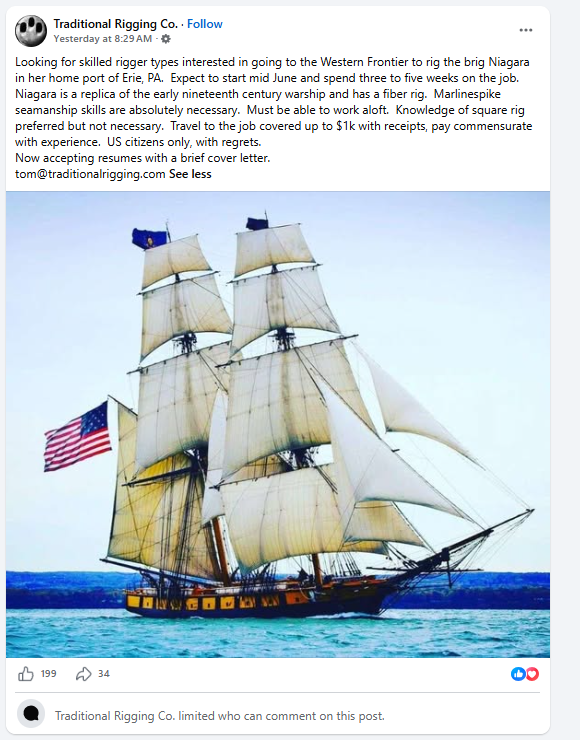
But I cannot pretend that the environment now surrounding her looks ready to regrow the community that made her meaningful. A ship can be repaired in a yard. Trust is harder. Community is harder. PHMC is turning, yet again, to a no-bid private contractor to rig the ship this summer. Maybe that gets the yards crossed and the lines rove and, in spite of everything, I wish them safety and success. But rigging Niagara was never just a task to be completed. It was one of the ways the ship taught people: how volunteers became community, how apprentices became crew, how knowledge passed hand to hand, and how the ship made strangers into shipmates.
My shipmates still exist. They are scattered now, but they still carry what Niagara gave them: discipline, skill, stubbornness, humor, tenderness, endurance, love of history, reverence for work well done, and the strange grace of learning to put ship and shipmate before self.
That will not be lost.
I hope Niagara finds her way back to being able to make people better than themselves again. I hope she finds her way back to a community that understands stewardship as something more than possession. I hope Pennsylvania remembers what kind of treasure she really has.
For that reason at least… don’t give up the ship… don’t give up your shipmates… don’t give up.


This post touched a place deep in my soul.
Niagara has been part of my life since the first time I sailed aboard her. Her photograph hangs in my office, and every day it reminds me of the lessons, friendships, and experiences she helped shape. After years of volunteering and later serving as crew, I grew in ways I never could have imagined.
I look at these old photos and remember the faces, the smiles, the exhaustion after a long day, the unwavering support of shipmates, and above all, the shared love of the journey. I don’t know if anyone has held the title since, but I still carry the honor and memory of being named Niagara’s first Ship’s Mother. It remains one of the greatest privileges of my life.
I spent countless hours aboard her while earning my master’s degree before eventually moving away to pursue my Ph.D. Today, I serve as a professor, yet Niagara is never far from my thoughts. I still love telling stories when students and visitors ask about the large framed photograph that hangs on my wall.
Niagara is so much more than a vessel. She is a living testament to the thousands of lives she has touched, inspired, and transformed. My hope is that her return to the water brings new beginnings, renewed purpose, and the same sense of peace, hope, and wonder that so many of us found watching the sunrise from aloft, the waves gently brushing her bow, and the journey she carried us on.
Respectfully,
Laurie Lawrence, PhD
Thank you for the well written explanation of what the hell happened. I have long supported the Niagara but did not fully understand what had happened between the FNL and the PHMC, this explains a lot .